Physical Address
304 North Cardinal St.
Dorchester Center, MA 02124
Physical Address
304 North Cardinal St.
Dorchester Center, MA 02124
I had no idea what lay ahead of me, probably nothing more than another hoax. Blue Hills Memorial Hospital had a long and uneventful history, yet the lore had lasted for decades. The stories I’d heard as a child were passed from generation to generation. In my eyes, the hospital had become legendary for no real reason.
The hospital was a mental facility first, built in 1901. I know just the term will bring images of screaming people and violent outbursts. Undoubtedly, with stereotypically filthy rooms and tortured screams of the criminally insane.
However, that formulaic image does not apply to Blue Hills. Throughout its history, in public and private view, the establishment was nothing like Bedlam. It was a private facility, and normally only the richest could afford to place their loved ones there. A few were admitted on recognition or reputation; however, most paid dramatically to place family there.
The luxurious price allowed the hospital to be a fine institution. The cleanliness of the place made it a popular facility, the staff were kind and gentle, and the patients were happy and stable while there. They always used state-of-the-art treatments and therapy. Even if their methods seem barbaric today, they were praised then.
There were a few instances of violence. But the simple presence of such mentalities promises some negative behavior. Even with these exceptions, their records were impressive. In fifty years, the Blue Hills Mental Facility only saw three violent deaths. Blue Hills Memorial, as it was changed to, has had around the same number.
I wanted to investigate the hospital as a paranormal researcher. I had for some time. I asked my attorney if I could check it out without drawing any attention to my activities.
He raised it a level and obtained both professional and legal permissions for my visit. The hospital allowed my investigation, only with specific terms that the name was never to be disclosed. The identity of the institution was to remain anonymous. I could only state what happened. The personnel were to remain equally protected and the facts were to be kept silent until publication of the story. Even then, I couldn’t release any identifying statements regarding Blue Hills.
So, why am I writing it now?
I don’t care. They can sue if they like.
I didn’t notice the room until the first night I examined the hospital’s exterior. I often utilize both day and night walks around the vicinity of the “active” area. I look for flaws in the roof, cracks in the structure, anything that might allow drafts or other disturbances inside the building.
I look for moisture damage, broken pipes, faulty ductwork, and foundation instability. I made my living as a real estate appraiser before going into the paranormal field. It has proven to be an invaluable set of skills that have saved me much vain investigation into simply unsound buildings.
Ah, yes. The Paranormal Bug. The virus that infected me with curiosity and a desire to learn as much as possible. Maybe it was spawned by my middle age and fear of personal mortality, but whatever the reason, it was the choice I made.
I could see a room on the third floor that was just unfinished. It was a strange area in the midst of functional spaces. The room was rather large, big enough to hold cabinets and a few desks, yet was unused. The walls were bare with white plaster on almost four of the walls. Only, there was an open spot on the fourth. It was not plastered, painted, or papered. The small, horizontal strips of wood attached to the room’s metal frame looked like a wooden cell in an antiquated prison. I studied the empty space as best I could.
How strange.
It was odd that a perfectly exploitable room was not equipped with some kind of function. Blue Hills converted to a general hospital in 1951 and had grown since. Two wings had been added, with several floors after that. It was growing in popularity and success . . . and ill-repute.
I walked toward the main entrance. I expected the staff to be reluctant and uncooperative. My prior research was based upon this expectation. I’d studied blueprints, history, newspapers, and local periodicals. The confessions and declarations of former and current patients who had witnessed odd events. While it was not spoken of openly, patients had talked. Relatives, friends of patients, voices had carried the stories throughout the region.
The next morning, I visited for my day examination. I introduced myself to the receptionist as a consultant and was directed to the office of the Administrator. She looked cold and merciless as she seated herself at her desk.
“Mr. Andrews. It’s good to see you.”
Spoken like a killer.
Her voice was deep and monotone. I knew she could speak in a gentler tone and seem much more maternal. I was unwanted, therefore spoken to like a nasty troublemaker. I tried to offer a ground of truce.
“Thank you. I’ve been admiring the hospital for a while. It is an impressive place.”
“Yes, I think so.” She threw me a questionable look. “At least, for now.”
“Ms. Dixon, I appreciate your concerns. However, there is a strict legal agreement for my investigation of this institution. You are aware of the terms, and I have agreed not to mention any details which might remotely identify this facility.”
“Still, what a ridiculous subject to write about, Mr. Andrews. Don’t you have any haunted houses or cemeteries to visit? Why my hospital?”
“Because it is the topic of many stories. I don’t care about naming this place. I don’t care to change a few details at all. I want to verify that there really is nothing here. I am paid for my disbelief as an investigator, Ms. Dixon. I wish I could lessen the hostility between us.”
“This hospital is my life. It has been for three generations of my family. My father, Trevor Dixon, loved this hospital more than anything. I must see that it is taken care of in the future. You were only granted permission because a few idiots on our Board of Trustees thought it would be good for patient morale if you could prove there was nothing ‘haunted’ here. Seems even they have heard disturbing and completely unfounded rumors about my hospital . . .”
Good God, how much more can I tell you?
I wanted to scream over and over. She asked the same questions repeatedly. While they were mentioned in different fashions, they all pounded the same question into my mind.
Will my hospital be safe? Will it be profitable?
I finally made it through the interrogation. I dealt with her wrath as smoothly as possible. There was nothing further I might say to convince her. I had signed legal forms, outlined a detailed proposal of how I planned to keep the institution private and anonymous. I even added what I might say to any patients or staff who asked my business. What could I possibly say, after that much work, to assure her otherwise?
Nothing.
She gave me the keys and a final warning.
“A word of this to anyone and you’ll never see daylight for the depth of the lawsuit.”
For once, I was glad to be in the hospital. I had escaped the offices of the administration and the insecure paranoia of the day.
I ate lunch and made notes on what I wanted to start with. Organization is imperative in my field. You must start with a goal. It works best if you can have a schedule. Your attention remains on that list and doesn’t have time to drift. It can be overwhelming to just step in a room and not know what to do first.
I returned to the hospital at night.
This was it.
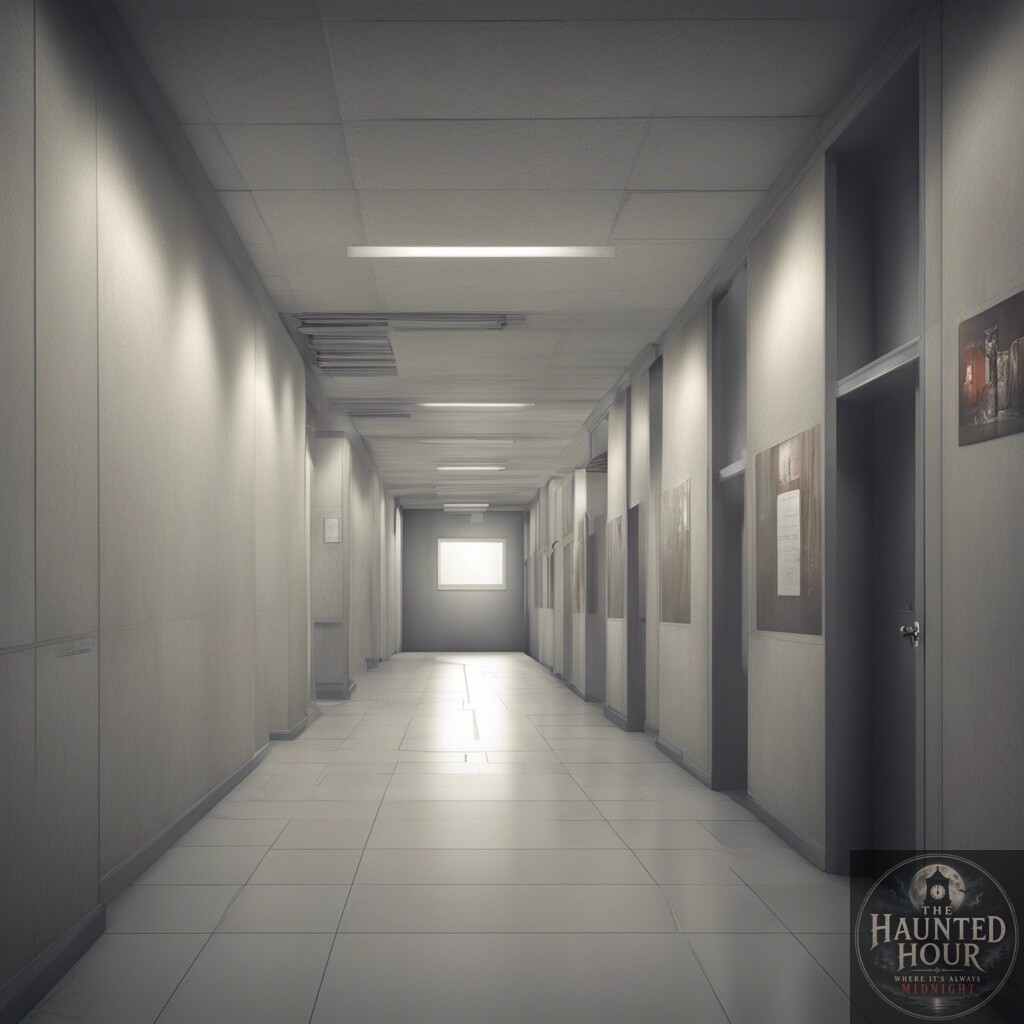
Visitor hours were over. Even the Emergency Room waiting area was relatively empty. I was free to roam. The third floor was where most activity was reported to take place. I had narrowed it down to a single floor with patient and visitor statements.
My interest was not in the floor so much as the empty room. The new discovery kept me on tenterhooks. I wondered if that was the room I’d heard so much about. Different people gave different accounts of equally different events, yet they all took place on the third floor. A few older patients even remarked about The Room, although I couldn’t get exact details on which room it was.
I had been in luck. The third floor was the main level for the offices of the hospital. The records, all the paperwork and accounts, were handled on the third floor. There was a single wing with patients on the third floor; however, that wing lay on the opposite side of the hospital. The empty room was in the middle of the office spaces.
I was puzzled that file cabinets were lined in the used rooms, making the space appear cramped and disorganized. The spare room, the empty room, looked as though it would hold enough to organize the other offices.
I found the appropriate wing. I had to pair the building up with the path where I stood the night before. When I found my directions, I could tell which side the room would be on.
It would be to my right.
I entered the first space and immediately went to the window. It wasn’t the right room. I walked past two doors, and at the third, I grew suspicious.
Unlike the other doors, which appeared well-worn with faded stains around the handle, this door looked almost new. The locks, which were scratched on the other doors, shone on this one.
Yet, as I looked through the window, I saw rows of cabinets. The room was filled to capacity.
What mistakes could I have made with my calculations? Was I on the correct side? I sat on the floor of the dim hall and mentally laid out the exterior of the hospital.
It finally dawned on me that I was doing an investigation and the entire floor was supposed to be haunted. I didn’t have to pressure myself about a single room. I would get to it eventually.
Hospitals are creepy.
There is no amount of foliage, potted plants, or luxury that can ease that. Everyone blames their negativity on jitters and bad nerves. The rest dismiss it as ill-health.
No one considers how many die in hospitals. I am not speaking morbidly per se, but through the logic of a paranormal investigator. Hospitals are the most haunted places on earth. If one person dies in a home, it becomes the subject of legend and lore.
Hospitals don’t.
With so many deaths in a single building, over years of time, common sense tells you there has to be activity. I think people are more sensitive than they believe. They are genuinely disturbed when they come to a hospital, not because of illness or personal feelings, but because they sense it. They know it, whether they acknowledge it or not.
I pulled out a digital recorder and a camera. I carry three recorders, two small cameras, and two dozen rolls of film. Better safe than sorry. I always carry portable equipment on my investigations. Modern technology has aided the paranormal as much as the living.
I switched the recorder on.
“This is the first few moments of investigation. I am sitting in the east wing of the third floor. Nothing has happened as of yet. Nothing unusual.”
I stood and paced the hall, carefully watching for another person.
“Who are you?” I asked. “Why are you here?”
I gave the tape a few minutes of recording on its own. I would check on it when the investigation ended. I don’t believe that a good investigator should look at the evidence they gather while they compile a case. It taints the mind and encourages imagination.
You must be clear-thinking when searching for the unbelievable. If you hear something strange on tape, you’ll start hearing it everywhere because you are seeking the same response. If you leave it and come back, you still have the evidence, and you will have made a clean observation of the area.
Likewise, I do not set my faith in mediums or spiritual advisors. I’m certain there are genuine, gifted individuals in the world, but this seems redundant at best. The entire mystery of a haunting or a paranormal investigation is that it manifests in front of normal people. If the activity is substantial and legitimate, it will exhibit regardless of your ESP capabilities.
I am not so certain these entities have unfinished business, as so often declared. Perhaps they are just marooned in a certain span of time. I suspect they are trapped in an element, on a plane, that none of us can possibly comprehend.
I turned the recording off and began to photograph the hall. The camera’s clicking would interfere if I left the recorder running. I walked down the second and third wings, occasionally snapping photographs. The patient ward was quiet, a few nurses lined the station. I didn’t go completely down the hall, and they didn’t pay any attention to me.
I came back to the mysterious room, so certain it was the empty space. How could it be filled with records? I walked farther down the hall and peeped into the other rooms. Everything looked fine and in order.
I didn’t bother to search all of the rooms yet. There hadn’t been anything to happen while I was there.
If a place is truly haunted, you won’t have to look for it.
It will show itself.
I didn’t agree with the use of electromagnetic meters or infrared cameras. I believe a haunting will manifest itself before a person. That is what makes it a haunting. If a structure is truly paranormally active, a camera and recorder will suffice.
Electromagnetic abnormalities don’t always indicate a haunting. They simply prove there is an odd energy field in a certain area. That can be altered by mere power lines and electric outlets.
I was a traditionalist in my field, a strict professional. There must have been impressive and dramatic activity to warrant my attention. I didn’t chase “orbs,” nor did I believe they held great significance. I wanted action, real and true manifestations. Not blips on my negatives or static on a meter.
A haunting is a visible occurrence that people hear and see. If it were only something that could be caught on specialized measuring devices, no one would report them.
I only used what equipment I could carry in my bag. I didn’t enjoy drawing attention to my work. Much of this is evident during my anger at the staff I previously mentioned.
People are not good with secrets or sensitive information. Had even the staff known the reasons for my visit, there would have been dire potential for interference, even tampering. More than a few times, during the earlier part of my career, the living around me were more threatening than any supernatural event. While they would hire me to investigate a building, they would then obliterate the investigation by installing cheap magician’s parlor tricks to “help” the search. It seemed to defeat the reason for my visiting.
After a few years, I learned to send out rules and regulations as soon as someone consulted with me. Any fraudulent attempts to “fudge” an investigation would result in my immediate abandoning the session, and they would receive a bill for a full night’s work.
Blue Hills was my own undertaking. I was not hired for the position. I planned on publishing my findings in the prestigious Vanderbilt Paranormal Society Journal. From the precautions I’d taken, I doubted any outside influence would be present. With the fear from the administration, I knew no one on staff would dare place any effort into a false presence. It would surely result in immediate dismissal and a nasty reference.
I strode the wing and peeked into all the rooms. None were empty. I did not know where the investigation would lead me. There was a massive amount of space to examine. To keep my work to a minimum, I took my camera outside. The recorder I left hidden behind a decorative plant beside the records department.
I walked down the stairwell. I didn’t wish to take the elevator. Too many chances someone would notice my getting off on a level in a staff-only wing. I made it down to the bottom and went back out through the entrance. I walked around the building, following my steps of the previous night.
I found the room.
I took four pictures of it for good measure.
It was one of the rooms I’d looked in.
The room was still barren and void of cabinets or people.
Yet that was impossible.
All the rooms on that side of the wing were occupied.
I hastily ascended the stairs. There was something amiss. I ventured into the hall and back to the side of the hospital where the room would be.
I had a night of work ahead of me.
I opened each room, starting with the first. One by one, I narrowed the possibilities down. All of the rooms were dimly lit and filled with cabinets and desks.
I came to the room I suspected and opened it.
The door with the shiny lock and clean face.
It had to be the one.
I retrieved my recorder and pulled out the keys.
I opened the door and stood for a moment, peeking around. I didn’t understand what I saw.
The room really was empty and unfurnished, just as it looked outside.
I looked back to the window from the rear and found the answer. A piece of decorated plastic was against the glass. It was like the decorations which cling to glass and other nonporous surfaces.
Camouflage to cover the room’s state of abandonment.
I stepped into the room.
What was it about this room?
I stood alone, waiting for something to happen. In retrospect, I wanted something to happen.
I stepped toward the window and looked down. There was the place I stood. I turned back to face the room and snapped a few pictures. I stepped away from the window. There was a chance someone might see me from outside.
I walked to the right wall and sat on the floor.
Again, I waited.
I turned my attention to paperwork, documenting the journey outside and finally locating the proper room.
A whisper caught my attention.
It wasn’t a violent whisper, nor was it deep and menacing. It was just a soft whisper that barely broke my attention.
“Pssst . . .”
I looked up from my work.
There was no one present.
I turned my attention back to notes and calculations.
“Pssst . . .”
Something was present.
The skin on my arms began to prickle. The hair at the nape of my neck arose. The room seemed to grow colder. All the classic signs were present.
I slowly reached for my recorder and flipped it on.
“Get me out of here,” the hushed voice quietly pleaded. “You don’t know what they’re doing to us.”
“What?”
I knew it would appear ridiculous to the average person. I was accustomed to blurting out questions while investigating.
“What are they doing?”
I pretended to know the speaker and that it was an outrage they might be mistreated. I hoped the caring tone of my voice would encourage them. I was on their side.
“Listen to me, get me out of here.”
Again, the voice.
It was stronger, yet emptier. There was no demonic tone, no anger or rage, not even tremendous sorrow or despondency. A small voice, possibly that of an older man or woman, delicately speaking.
“Help me . . .”
“I want to,” I said. “But I need to know what’s happening. How can I help if I don’t?”
“Oh, God . . . spiders . . .”
That sweet voice had muttered its last whisper.
Next came a darker voice, one that did sound sinister and dubious. I was not afraid. It was my job to expect those things. I felt like I was speaking to another person.
Basically, that is where the majority of people err. It is a genuine conversation. The only difference is you can’t see the person. It doesn’t take a special talent to do it.
It just happens.
“Are you expectin’ something?” a menacing voice demanded.
“No, please. It’s not what you think.”
Another gentle feminine whisper emerged.
I followed the sound of their voices and wound up next to the west wall of the room. Quickly, I took several pictures of the area.
The next event puzzled me.
The deep voice demanded, “You’re working for them, aren’t you?”
A light female voice trembled.
“No, please. I just need to give you your medicine. Please, don’t hurt me.”
I was helpless, my own heart beating rapidly. How could I help someone I couldn’t see? I tried to follow her pleas for mercy and kindness.
I couldn’t help her.
My excitement for the haunting was overshadowed by my sentiment.
The poor girl was terrified.
“Now, we’ll see who you work for. I’ll bet you tell if I hurt you.”
“I don’t work for anyone, honestly. I’m just here to give you your pills. Please, this is just a big misunderstanding. Let me go and I won’t say a word.”
“It’s too late for that . . .”
As the voice trailed off, I knew something was wrong. Blue Hills was a quiet place. There was no violence.
The menacing speaker sounded bloodthirsty.
“Now, we must do something with you. But what?”
She was quiet.
The argument from the girl and the man seemed to float to different locations. It seemed whenever I tried to follow the audible presence, it moved.
I snapped picture after picture until my camera had filled the roll of film. I quickly changed to a fresh cartridge and began speaking.
“What is going on?”
I spoke firmly.
The voices stopped.
It was dead silence, even quieter than the stillness of a normal room. It was a cool, dead sound that made everything chilly. I slipped into my jacket as I walked around the room.
Were they gone already?
Another set of voices arose while I looked for the previous couple.
“How dare you treat me this way.”
It was an older man’s voice.
A younger man defended himself.
“This is a medical institution. You are a corrupt leader and I am turning you in.”
The older man grew furious. His anger bellowed through the silence.
“Like hell you will. No pathetic first-year resident will tarnish the image of ‘Trevor Dixon.’ I’ll see you in hell first.”
The voices died.
Even if Dixon hadn’t admitted it, I knew somehow Trevor would be linked with her.
I was strangely grateful I’d heard the voices of the past and equally saddened to hear their tragedies. With a normal haunting, you are afforded the luxury of speculation. You can believe the person could defend themselves, or their death was not violent.
When you heard it, that robbed you of that.
You couldn’t make yourself believe that they were strong enough to put up a good fight, or that the odds weren’t completely against them.
I felt my own panic start. I assumed it was my imagination working its way out. I felt fear and claustrophobia within the unfinished room.
I couldn’t stand it.
I had to get out for a moment.
I snapped a few pictures of the empty space around me and went back to the door.
It was locked.
The door was locked.
It locked from the inside, and I couldn’t budge the latch. I pulled and jiggled the handle. It wouldn’t budge.
I felt something behind me.
Something terrible.
Yet, I couldn’t see anything.
I snapped my photos like crazy, the shutter from the camera constantly clicking and winding.
Yet there was nothing.
I imagined my things would begin to move about, yet they didn’t. I waited for my recorder to fly through the air.
I turned back to the door. Chills went up my back as I stood in the silent room. I felt strangely disappointed that the voices had died so suddenly.
I felt like an auditory peeping Tom who had witnessed events which should’ve been secret.
Who were the people?
What did they want?
My heart had gone out to the victims, whoever they were.
I noticed my watch had stopped as my attention returned to the door. I reached to tap the lock in the knob with my signet ring. I prayed it would somehow ease the door’s ability to open. It was almost completely unused. Perhaps the lack of use caused problems when opening and closing the door.
My watch stopped at exactly 9:45.
The time I entered the room.
I opened my cell phone to check it out. Sometimes any odd fields of energy would interfere with electronics. In some cases, there was no interference at all. I dreaded calling the icy Administrator, but I couldn’t budge the door. She would smirk and sneer, but I didn’t care.
I was tired of the room.
I flipped it open and listened.
It was dead.
I pressed the “on” button, but it refused to wake. I tapped the back of the Motorola and hoped for a response. It beeped when it was opened; however, there was no dial tone.
“Hello?” I cautiously asked, not knowing what to expect.
“Who is this?”
The same hateful voice which had argued with the girl.
“I’m trying to get through on this line. Who are you?”
I tried to be reasonable. The situation was unlikely and improbable.
But I needed to go with it.
“Line? What the hell are you talking about? There is no line. What the hell are you doing in my room?”
“I’m afraid I’m lost. I can’t seem to find the right way out of the room.”
I hoped the voice would comply. Perhaps I had done something wrong. Maybe the door refused to move because there was a secret “trick” to opening it.
“Who the hell is this?”
I could tell the voice was growing angrier. The tone rose an octave and was becoming malicious.
“Listen, pal. You’d be wise to get the hell out of my room.”
I couldn’t understand him. I knew he didn’t understand me.
I tried pleading.
“I’d love to. I don’t know where. I can’t get the door to work.”
“Bullshit.”
The malignant voice became deeper and more hateful.
“You’re working for them, too. Just like that bitch who came in here earlier. If you’ll look to your right, you’ll see what I did with her. Told her a thing or two.”
I ran to my camera and took more pictures along the walls. I followed the direction given by the voice and snapped. Although I couldn’t see anything, I snapped pictures.
There might be shadows or something indicating a presence.
I knew just by the wrathful tone of the voice as it spoke, he had done something terrible.
My mind whirled through the possibilities of what I might say. I couldn’t find a reason why I was there that he would understand.
The small glass pane of the door frosted over. I reached to scratch the ice off and found it solid.
I stepped back and scanned the room. The exterior window was merely decoration. There was no latch or handle where I might open it. I knew it was thick. I’d examined it as a potential source for drafts earlier. The glass appeared at least one inch thick.
My fear was no longer just a gnawing feeling in the back of my mind. It rushed forward before I could prevent it. It was swift and merciless, and I couldn’t do anything about the situation I was in.
I believe that is the most amazing sensation a human can feel.
Fear.
My fascination with that element was one of the reasons I left appraisal for the paranormal.
Fear is a feeling, something without substance or tangibility. Yet it can render completely healthy and productive adults disabled. They are frozen in their own homes. It can become so severe, people are too terrified to walk quickly or go through a drive-through at a restaurant.
It is a primitive instinct that never softened. We are as afraid today as we were thousands of years ago. Even the reflex of “fight or flight” is still with us. The human mind is a brilliant thing, made by an obvious master.
My fascination also went to the militant skeptics. People who refuse to acknowledge the power of fear and the questionable situations which provoke it. As though their distance from it, no matter how illogical, will stop them from ever encountering the emotion.
I have considered the fact that they are afraid of belief.
That is their fear.
I stood in the room, uncertain of what might manifest or take place.
I’d never been in such a situation before.
The voice sensed my hesitation. I could hear it come across the line.
“Get out.”
I could tell the man was serious, that he had every intention of harming me if I didn’t listen.
I knew I’d heard a killer.
The voice was the same man, yet he sounded much worse than when he spoke to the girl. I tried, but still couldn’t open the door.
“I can’t open the door. Could you please get it? My arthritis is so bad today. Could you please help?”
The line went dead for a moment, just like the room. I almost expected it to be cooperative.
Yet, the large window frosted over in the same thick, impenetrable coating of ice.
Air swirled through the room.
It wasn’t the common cool draft, not even the typical “cold spots” which are so often discussed on paranormal programming. These were sharp and biting drafts, so cold the air stung as it whipped past my face. The gusts weren’t light and playful.
They were brutal and relentless.
The air blew my recorder until it hit my shoe. Out of my own fearful instinct, I held the tiny microphone to the earpiece of the phone.
The voice again spoke.
“I don’t think you heard me correctly. I told you to get out. I mean now, shithead. Are you waiting for a tip? How’s this, get out or I’ll rip your fuckin’ head from your shoulders. Is that good enough? What about get out before I crack your skull against the wall. You are just like that nurse . . .”
I waited a moment, waiting for something to happen.
Anything.
The voice came back, only it wasn’t on the cell phone anymore.
It was standing around me.
Its voice encompassed me.
“What about I throw you through the window? You have arthritis like I have patience. You know that, don’t you?”
I couldn’t speak to the malevolent spirit.
He was in front of me.
I snapped more pictures and waited for the man to tell me to stop.
He didn’t.
I didn’t speak as he moved. He drifted away from me.
“Fine, don’t answer me. I’ll just walk around this room until I can get to you. You sorry bastard. I’ll rip your eyes out, just like that slut’s there.”
I slid along the wall to the door.
Something was wrong with him.
He couldn’t hear or see when I snapped the photographs.
He couldn’t tell when I moved.
He came back to where I had stood and a sudden thud shook the wall. The plaster splintered beneath the force of the unseen hand.
I could clearly see a dent where I had been.
I was breathless, but I had to snap more pictures.
I backed up against the door, my hand constantly turning the knob.
It remained frozen.
I couldn’t budge the piece.
The strong drafts chapped my lips. I knew my face was wind-burned. It wouldn’t stop stinging even when the air died down.
The voice patrolled.
“Yeah, I’ll find you. Where are you? I will see you and when I do, you’ll be sorry.”
I slid down the door.
It was hopeless.
There was no one in the hall, no one around. I couldn’t knock. It wouldn’t do any good. The patient ward was the second one over from where I was.
No one would hear me.
Why didn’t anyone warn me about this room?
The single thought repeated through my mind.
Why didn’t Dixon tell me about this room? Ghost stories are my life. It’s not like I would’ve dismissed her tales. She had to keep the damn hospital, the precious hospital safe.
The name of the institution was so . . .
So . . .
It occurred to me.
The conversation went through my mind again:
“This is a medical institution. You are a corrupt leader and I plan on turning you in.”
“Like hell you will. No pathetic first-year resident will tarnish the image of Trevor Dixon or Blue Hills. I’ll see you in hell first.”
What did they do?
What the hell was that about?
Did Dixon know this would happen?
Did she suspect it?
Her office was on the opposite wing, on the third floor. She could’ve watched me examining the room the night before.
I suddenly remembered a figure standing in a room in that wing. A feminine figure which watched me as I explored. I believed it was just a visitor; however, after evaluating the layout of the place, it was her office.
I knew more than I wanted to.
Suddenly, I didn’t want to know about the corruption, nor what happened to the young man when he confronted Trevor.
I didn’t want to know anything but how to get out.
Could Dixon have planned it all out?
I waited for the room to stop. The drafts continued, although the voice had vanished.
I dared to pick the telephone up again.
It was the voices of Trevor and the young resident.
“Who the hell do you think you are? How could you treat patients so terribly? You’re supposed to be helping them, not hurting them!”
The young man’s voice was passionate and sincere while the older man scolded.
“You are pathetic, you know that? Where do you think that bleeding heart will get you? You aren’t impressing anyone with that phony show of compassion. You treat these loonies for what they are. Animals.”
There was silence and the sounds of a struggle.
“You are cruel and evil, you bastard.”
The young man was becoming more intense, and I heard them hitting one another.
“I hope that you pay for your actions, Trevor Dixon. I hope you pay.”
“I’m the Administrator, you foolish brat. Tomorrow morning, you can find another hospital. If you see tomorrow morning.”
The voices were smothered.
Silence again encompassed me.
I kept twisting the knob, and the door wouldn’t move. I couldn’t get through the ice. My fingers felt numb from digging. I could only make feeble attempts to twist the knob.
The room seemed to twirl.
It spun before me.
I felt nauseous inside the small space. The mad carousel that wouldn’t stop.
I curled up in a fetal position where I sat. It was more than I wanted, much more than I needed. I would’ve been happy with just the voice recordings.
They didn’t have to communicate.
Another voice started from the opposite corner. The right wall, in the corner next to the window.
It was where the plaster had been removed, or unfinished.
“Along came a spider . . .”
It was a man’s voice. I didn’t know if he were drunk or there was something wrong with him.
I listened.
I had no choice.
“And sat down beside her, and frightened Miss Muffet away. I am the Spider, the great big spider, that slithered down her back . . .”
I felt fingers of ice grip my neck, and I put both hands over the area. I could feel ice beneath my hands, and I couldn’t feel my hands on my neck.
I was touching something.
Dear God, there was something on my neck I couldn’t pry off.
“I went to hide her, I went to hide her, when she suffered that . . .”
I didn’t know what the voice was talking about.
What did the woman suffer?
I had no idea about this scary speaker. The new voice hadn’t talked all night. My watch didn’t work. I guessed it was around midnight.
It would be eight hours before someone arrived in the offices around me.
Eight long hours of waiting inside the array of past lives and crimes.
My cell phone rang.
I laughed aloud, not caring what force heard me or noticed me.
Someone was calling me.
Someone on the outside had wanted something.
My phone must be clear.
I picked up the ringing piece and listened.
My heart froze.
“She really suffered that . . . She really suffered that . . . Along came the spider, I sat down beside her. I put a knife in her back, that’s when she suffered that . . .”
I could barely hold the recorder to the phone. My hands shook, and I couldn’t speak.
I was too afraid to speak to the voice in the telephone.
Unlike the others, this was empty and deep. A fathomless abyss of dismal energy radiated from it.
I felt like I was talking to a thing, not a person.
“You know what she suffered . . .”
The voice paused.
It was speaking to me.
To me.
My backbone felt like pure gelatin. I couldn’t breathe.
That thing was addressing me.
“Hey, mister.”
It deepened into a low rasp.
“Can you spare a dime? I’ll tell you the rest of it.”
“Sure,” I immediately agreed in a whisper.
I’d agree with anything the voice wanted at that point. After the violent outburst from the militant man who attacked the girl, who knew what the thing on the other end would do if provoked?
The voice laughed.
“That’s right. You don’t know what I’ll do. I am the Spider, you know. At least, that’s what the papers call me. I don’t think I’m a spider at all. A monster, maybe. Not a spider. You know what I do?”
I knew.
I could easily see that voice standing over a corpse.
I said nothing other than, “I don’t know. Tell me.”
“I creep up on people. I walk up on them like a spider. When they are dining or driving around in their fancy Model Ts. When they are going to see the moving pictures or parking where they shouldn’t be. I sneak up on them. They pay all right. They pay . . .”
“Why?” I sheepishly asked.
I didn’t want to know.
I didn’t care.
“Because I can . . .”
The answer didn’t surprise me.
Not at all.
“Why do they say such things about you?”
“I’ve killed twenty, going on thirty. I want to kill at least forty or fifty.”
“Why?”
“I am the Spider. I have a nest I must line. What better way to decorate than with the bones of your enemies?”
“Enemies?”
“I learned during the big War that enemies surround you. They surround you.”
I wedged the door open at six in the morning.
Voices drove me from one side of the room to the other, over and over. It was still dark outside, and the wing was deserted. I fell out the door and onto my face.
I barely had time to grab my things.
The activity grew stronger as the night progressed. I closed my eyes to rest for a moment. Fear had another side effect: exhaustion.
I couldn’t believe what I’d heard or seen. I’d snapped five rolls of film and filled up several recorders.
It became so intense that I stopped moving, period. The drafts became so severe, I could barely breathe. My lungs felt like they would turn to ice.
I shivered as I lay in the hall.
I was retiring.
I knew it.
I had found the pinnacle of my career and was happy to have it over with.
I rested until seven and stood. I could walk again. My legs shook, but my mobility had returned. I didn’t dare go back into the room.
I knew what waited for me there.
I snapped a few pictures of the halls.
No more rooms.
I walked through the empty wings and took a few photos in the stairwell. As I walked away from the hospital entrance, I reached the end of the sidewalk where the parking lot started and glanced back.
The unfinished room was barren and looked just as it had the night before. The clear window looked freshly cleaned.
The dent in the wall was gone.
I looked over to the opposite wing, and as I figured, a figure stood in the window.
A female figure.
I believed she was smiling.
I left the hospital, not knowing if I would even publish the findings. I was too afraid to develop the pictures I’d taken or listen to the tapes.
I went home and placed the tapes and film rolls in a drawer with a lock.
No more.
My curiosity got the best of me within a few weeks. I really was interested in hearing what went on in that room.
I even developed the pictures.
The voices were there.
I carefully took notes of the names and activities mentioned, and I found the legend of Blue Hills.
The Room, as it was called, was only room 303 of the old hospital.
The only room where three violent deaths at the hospital occurred.
The girl was a young nurse, victim of Earnest Lee. A man convicted of murdering five people, he was being evaluated when he assaulted Miss Annabel Rose. She was just starting her work as a nurse, and they sent her to give him a sedative.
I knew, from the first mention of the incident, that she was the scapegoat of the ward. It was very unprofessional of the older nurses to send an inexperienced girl to a madman’s room. There should’ve been a group with her, if not two older and more knowledgeable women.
Her death was brutal and was not discovered for hours. No one knew how long she’d suffered or when she’d died. Earnest refused to give details as to what happened. At least, he refused to tell the reporters.
He was executed several months after her death.
Roger Faust, a young resident, had “killed himself” at the hospital.
I knew what happened to him.
I knew.
There was no subterfuge, regardless of what the papers reported.
He was found on the stairwell. He had a rope tied around his neck. Apparently, to hang himself, he attached one end of the rope to the stair railing and the other around his neck. The papers reported that he flung himself down a flight of steps.
That was the explanation offered as to why he was so badly beaten.
I looked up the doctor in the microfiche rolls at the library. Papers from half a century ago.
Doctor Dixon had attended the funeral of the resident. He was openly emotional and offered his sympathies to the grieving family. Yet I noticed in the photos, one eye looked blackened. There was a hint of a cut on his lip in the paper’s photographs.
I even found the Spider.
Henry Falen, a killer convicted in the 1920s, was there. His rich family placed him there. Henry was the black sheep of the family, the carefree spirit, as well-to-do families like to say to cover irresponsible adults.
After he returned from the First World War, he was changed. No longer just drunken and irresponsible, he was violent and brutal.
Henry had killed many. They averaged the number at fifteen, although he admitted to many others. He crept up on people, as the papers said. He liked to surprise them.
He committed suicide in Blue Hills. They found him sitting against the wall. He had beaten his own head so hard into the plaster wall, it fractured his skull.
I developed the pictures after much soul-searching and consideration. I couldn’t change anything I found. If it reminded me too greatly, I could get rid of them.
I was amazed.
There were people of all kinds lining the empty hallway. People stood near and far. Some were engrossed in conversation, just like the living.
The one photograph which encouraged my retirement was a hallway shot.
Three people, spirits I should say, stood looking at the camera. Their smiles were wide and their eyes were strange.
In the picture, you can see the paintings on the wall through them.
The photos from the room took me several weeks to fully examine. Each photo brought a new fear to my own heart. I had to wait a few days before examining a new one.
I captured all of them there.
Annabel, Roger, Earnest, and Henry.
They were all at different moments during their lives.
Annabel wore the typical nurses’ uniform, like the ones from the old black-and-white movies. She was covered in gore, her young head lolled to one side. Her eyes were gouged out and thick streams of blood had run from the sockets. It was clear that her neck was broken, for no human can twist their head to that angle.
On the bed, Lee grinned at the camera. His blackened teeth looked jagged and his eyes were hateful.
Trevor had his hands around Roger’s throat. Roger’s face was twisted into a purple grimace.
The doctor scared me.
I still refuse to see a doctor with the same angry red hair.
Be it silly, I don’t care.
The Spider was the most vivid.
He sat at the wall. I knew it was the wall he died at. The place where the plaster was removed.
The back of his head was painfully flat against the plaster. The spider-web fracture made his name suit him further. I wondered if he knew it would fracture so perfectly.
In examining the blueprints of the hospital, there was a mention of some walls which would not hold plaster. They said it was due to structural instability and—
I had the photos where I felt someone near me developed.
The Spider was behind me.
Right behind me, with his hands reaching toward me.
He looked crazed and ready to kill again. His mad eyes were less than a foot from the camera lens. The red gleam in his eyes made him seem menacingly human and real.
The digital recordings were equally terrorizing. The first, from the hall, was crowded with voices. All types of people talking and crying. Some were fussing and others discussed politics and current events. They were all current at some time:
Should Truman have authorized the bomb? Was it right to accuse movie stars of being Communists? Have you seen the new moving pictures? Did you hear about the Titanic last year? Did the Dodgers win the World Series? Has anyone noticed the mortal? I wish it would stop raining. It’s always raining. Why can’t I see my family? Why can’t I hold my wife? Where did they all go?
It’s fascinating to listen to them.
I was more compelled than fearful. They were all conversing as though time had stopped and they were in a cozy café somewhere. I was amused at the few who did notice me.
They seemed much less threatening after hearing their normal voices.
At the start of the recording, when I had just arrived in front of the door, it amazed me. My voice was in stark contrast to the ebbing voices around me.
I transcribed the brief session:
“Who are you?”
I recalled standing in the middle of the empty hall, bag still in my hand.
“I’m the Spider.”
“My name is Lana.”
“Felecia.”
“Alice.”
“Mortimer.”
“Randall.”
“I’m Monica.”
“Randolph.”
“Burt.”
“Thomas.”
“Dorian . . .”
The voices kept saying names, a different voice for every name.
“Why are you here?”
“I work here.”
“I have to stay here since . . . since the accident.”
“Because he’s fucking nuts. The Spider, my ass. He’s a loon from the War that never got spotted.”
“Because I have to be.”
“Where’s my family? I’m here to see them?”
“I’m sick. I’m so sick.”
“Get them off me! Get them off me!”
“I don’t want to be here. Can you get me out?”
“Where the hell is my medicine, Nurse! You bitch, get me my morphine!”
A different voice for each reply.
I couldn’t keep a record of names and replies. I tried that before. After a while of steadily listening to the voices, their tones seemed to merge.
I never spoke with the hospital again.
I never published my findings.
I still can’t do many things I used to. My fascination with fear has invoked some strange fears for me.
I’m afraid to sleep with the lights out now.
Sounds pretty pathetic, I know.
I just keep seeing Annabel and the Spider when I’m in the dark. Keep feeling those icy fingers on my neck. I started taking medication for anxiety, but it doesn’t always help.
I can’t visit hospitals, nor do I want to.
That night almost killed me. I’ve never been more afraid or petrified. I couldn’t move.
I literally couldn’t move.
I never really believed I would see anything of importance at the hospital. I figured a few cool spots, perhaps a slight ghost or two.
Certainly nothing abnormal.
It’s a hospital.
People die there.
I find myself incapacitated with fear at times. Illogical and unreasonable fear.
What if I go here and find something paranormal?
What if it all comes crashing down upon me as it did that night?
What if I’m the only person to see or hear things of that nature?
What if I published that piece and found that no one in the hospital would agree or disagree? That they would ignore me.
Surely, I’m not the only person to see it.
Or feel it.
At times, it can grow worse.
I’m terrified and I don’t know why. There is no reason.
I feel like something will just happen. I can feel eyes on me, or things near me.
The other wings of the hospital revealed few people. I believe the spirits come to the older part when they arise.
Yes, fear is fascinating.
I say, with bitter regret, that it used to be my profession.
I haven’t studied paranormal activity in over a year.
I haven’t been out of my home in six months.
Fascinating . . .
“They pay all right. They pay . . .”